Dry East County air already stresses oaks and eucalyptus on Alpine lots above I-8. When the National Weather Service describes a Santa Ana pattern, that is pressure-driven desert flow through mountain passages, most often in the cooler months from September through May. The useful move is not a countywide trim-everything calendar. It is a walk of your trees, roofs, slopes, and access before you hire tree trimming.
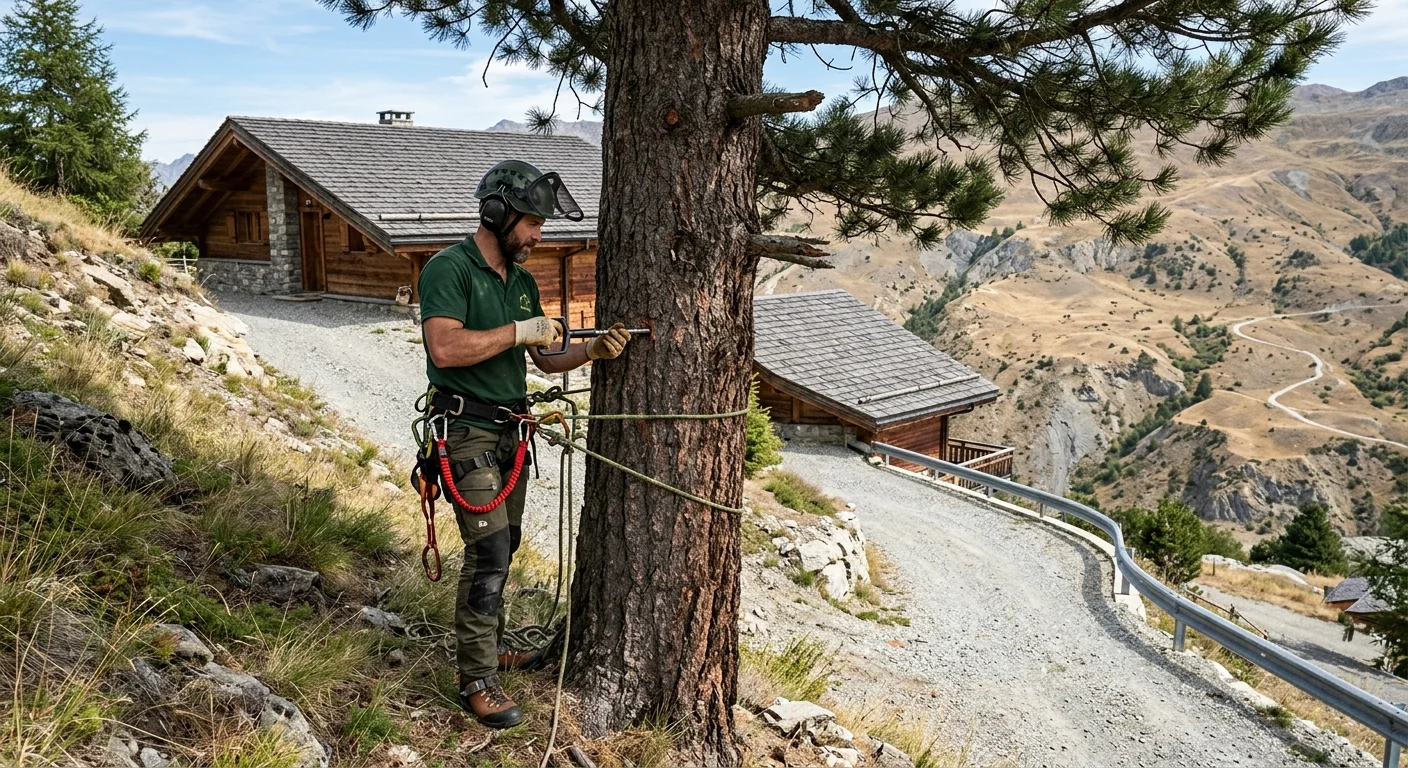
Start with the concern the homeowner wants assessed
Name the worry in one line before anyone brings a saw. A dead limb over the metal roof on Tavern Road is one job. A coast live oak hanging over the only driveway off Alpine Boulevard is another. Chaparral against a fence on a Peutz Valley slope is usually a clearing question, not a pruning question. Write the target, the tree, and what you want left standing.
Alpine is unincorporated East County, not a coastal street-tree neighborhood. Lots sit on granite pads, long decomposed-granite drives, and canyon edges near Viejas Grade and South Grade Road. Heat, drought, and dry wind hit harder here than they do in Encinitas or La Jolla. That inland mix is why a coastal schedule does not travel. Our coastal versus inland trimming guide is the comparison. This page is the Alpine walk.
Check the forecast for your point, not a county rumor. The local National Weather Service office is NWS San Diego. Use the address or ZIP forecast. Do not treat a map stamp, a radar name, or a neighbor’s last wind event as this year’s order to cut. A forecast is time to finish safe ground work: photos from a stable place, a written list of trees, and parked cars moved off the fall line. It is not time to climb, winch, or prune an unstable tree.
Stay off the tree. Stay away from lines. If a limb is on a wire, or a line is down, keep people and tools back, call 911, and call SDG&E at 1-800-411-7343. The utility decides whether a line can be de-energized, covered, or moved. An ordinary tree company is not authorized to work an energized conductor. Private quote calls come after that routing, not instead of it.
Not every Alpine tree needs a pre-wind haircut. ISA’s mature-tree guidance is purpose-based. Each cut should have a reason: deadwood, a failed union, clearance from a roof, or a defect the assessor can show you. Routine thinning is not a proven way to make a tree “wind-proof.” If the real issue is root movement, a fresh lean, or a split trunk, pruning the crown does not fix the anchorage. Say that out loud on the walk so the quote matches the concern.
Document canopy changes, broken limbs, and recent pruning
Walk the canopy from the ground. Note deadwood, hangers, cracks, included bark, and old topping sprouts. Compare this year with last year’s photos if you have them. Early color, thin tips, or a one-sided crown can mean stress. They are not a remote diagnosis. UC Cooperative Extension treats early color as a reason to compare the tree with its history and with similar trees nearby, not as proof of one pest.
Oaks matter on many Alpine slopes. Goldspotted oak borer is contributing to oak mortality in many areas throughout San Diego County. Crown thinning and bark staining are nonspecific. D-shaped exit holes are a different clue, and even that is not a homeowner diagnosis. Do not peel bark, climb, or decide removal from a photo. Keep suspect oak wood on site until a qualified professional and the applicable disposal rules are clear. UC ANR warns against moving infested oak firewood into new areas.
Look at recent cuts as hard as you look at new deadwood. Lion-tailing strips interior foliage and leaves a tuft at the end of the limb. Topping leaves stubs and weakly attached sprouts. ISA’s topping brochure is blunt: indiscriminate heading can stress the tree, open it to sun injury and decay, and grow poorly attached regrowth. That is the opposite of wind preparation. If a prior crew already stripped the interior, the next visit should be an assessment, not another round of the same cuts.
ISA presents 25 percent canopy removal as a general upper guideline, and less than that for mature trees, depending on size, species, age, and objective. It is not a yearly quota and not a Santa Ana special. Structural pruning is named cuts with a written objective. Ask the independent company to mark or photograph the limbs they intend to take, and to say what they will leave.
Birds can nest in any month in parts of California. CDFW describes February through August as typical for many species, varying by location and species. If work must happen when birds could be nesting, CDFW recommends a consulting biologist’s survey. If a nest is active, the usual paths are a protective buffer or delay until nesting is complete. Do not move nests or poke them to “check.” An occupied nest is not a pruning permission slip.
Take photos only from a place that is already safe. Do not circle a cracked limb, walk under hangers, or get on the roof for a better angle. A clear ground shot of the trunk flare, the defect, the target (roof, drive, play set), and the access path is enough for a first quote conversation.
Map slopes, roofs, driveways, and work access
Alpine work is often access work. Sketch the driveway grade, the turnaround, gates, overhead lines, and the fall line toward the house. A chipper that fits a flat Lakeside cul-de-sac may not make a steep two-track off Willows Road. Write down where debris will land. On a slope, cut material travels farther than people expect.
Map the targets, not just the tree. Roof, chimney, patio cover, parked cars, propane, fences, and the neighbor’s structure all change the method. A limb over composition shingles is a different drop plan than a limb over a metal roof that funnels everything into a gutter. If the only drop zone is the driveway, say so. If a crane pad would sit on fill, a septic lid, or a narrow shoulder, say that too. California’s crane ground-support rule looks at slope, compaction, drainage, and known underground voids. The company on site has to assess that. You do not need to design the lift.
Power and communications lines along Alpine Boulevard, Tavern Road, and canyon laterals are common. Do not classify wires by height, color, or “they look like cable.” If vegetation is in conflict with a utility line, start with SDG&E, not with a ladder. SDG&E’s tree-safety material is the customer path for utility vegetation questions. Planting buffers on a utility page are not a DIY clearance recipe.
Note private lines the utility will not mark. Irrigation, a septic lateral, a propane run, and landscape lighting are often the owner’s problem. DigAlert covers San Diego County for member utilities when excavation or powered digging is in play. Member marks usually run to the meter, not through every private line, and marks do not establish depth. If the job later includes stump grinding or root work, that locate step belongs in the written scope. Trimming from the ground does not skip the line question if the crew still has to stage equipment.
HOA or recorded landscape requirements, if you have them, belong in the same map. Alpine is not one covenant. A postal city name does not prove Association rules, County rules, or a neighbor’s easement. Bring the recorded map or CC&Rs to the walk if they exist. Do not assume a fence is the legal line.
Separate tree pruning from brush-clearing work
Pruning a shade tree and clearing brush are different scopes. Mixing them in one vague “make it fire-safe” request is how quotes talk past each other. Tree work is named trees, named cuts, and debris from those cuts. Brush work is native or ornamental understory, grasses, and the horizontal fuel between trees. Our East County brush and Santa Ana guide is the clearing companion. Keep this visit about the trees unless you are also hiring clearing.
California Public Resources Code 4291 requires 100 feet of defensible space around structures in State Responsibility Areas and Very High Fire Hazard Severity Zones, or to the property line, whichever is less. CAL FIRE’s public guidance treats Zone 1 as the area within 30 feet (or the line) and Zone 2 as 30 to 100 feet. Spacing depends on vegetation and slope. There is no universal “cut every lower limb to ten feet” rule you should copy from a blog.
Zone 0 is the first five feet. Statewide, CAL FIRE’s Ready for Wildfire page still describes that ember-resistant zone as not legally required yet. The Board of Forestry approved a final draft in August 2026. As of early September 2026, the Office of Administrative Law still listed the package under review. Do not treat that as an immediate order to strip every living plant in the first five feet. Confirm the mapped hazard, the responsible fire authority, and the written requirements for your Alpine address. Start with CAL FIRE’s defensible-space page.
Alpine parcels are County land, not City of San Diego street-tree inventory. County Planning & Development Services is the planning jurisdiction for the unincorporated community. PDS-800 describes vegetation clearing, including brushing, and it is not a blank check. Existing dwellings, previously improved acreage, MSCP or PAMA status, vacant land, and recorded open-space easements all affect what you may disturb. Fire clearing still stops at the property line and still has to match the fire district’s written requirements. Do not clear a neighbor’s slope. Do not assume an easement is yours to grub.
A hanging eucalyptus limb over a roof is still a tree decision even when the rest of the lot needs brush work. A healthy oak with a clean structure may stay, with deadwood taken and understory handled separately. Ask the company to split the proposal: tree pruning, then clearing, then anything else (stump, haul-off, replant). If one crew will not do both, that is a fact to know before you hire, not a surprise on the day.
Confirm the scope and current local requirements
Confirm the parcel. Alpine is on the County’s unincorporated community list. A mailing address is not a jurisdiction test. Use the APN with County PDS when the work touches native vegetation, grading, or a development condition. City of San Diego street-tree permits do not apply to a private Alpine yard. If a tree is in a public right-of-way, that is a different owner and a different permission path. Do not hire a private crew to take a public tree.
California requires a contractor license for tree work at or above the current minor-work threshold. The current Business and Professions Code section 7048 exemption is only for an aggregate project price under $1,000, including labor, materials, and other items, and only for casual, minor, or inconsequential work that does not need a building permit. Advertising as a contractor, employing others, or splitting a larger job to stay under the number knocks the exemption out. For paid tree service in Alpine, look up the company on the CSLB license search. Tree work is C-49 Tree and Palm, or a legacy C-61/D-49 issued before January 1, 2024. An active legacy D-49 is not automatically invalid. ISA Certified Arborist is a separate individual credential, not a California license. Ask for the license number and check it. Do not treat a missing ISA directory listing as proof either way.
No .gov source publishes an official Alpine pruning price. Ignore round-number “averages.” Ask for a written quote that names the trees, the cuts, debris handling, chip disposal, access limits, and what is excluded. There is no confirmed countywide free senior tree-cut program to point you to here. If cost is the barrier, check current County or fire-authority assistance listings yourself, then still verify the contractor on CSLB.
There are no universal months when you must not trim. Hazard work is year-round. Nesting risk is higher in the typical February through August window. Fruit trees, palms, and oaks have their own timing questions that belong on a species-specific plan, not on a Santa Ana flyer. Agree the objective, then let the independent company schedule around weather, access, and those biological limits.
Branch Pro San Diego is a referral service. We match you with licensed, independent local tree companies. We do not send our own crews, own no trucks, and do not set the company’s price. The contract and the work sit with the pro you hire.
When to call us
Call when an Alpine tree is over a roof, a drive, or a line of travel, and you need a licensed company to assess named cuts instead of a seasonal guess. Call after you have photos from a safe place, a sketch of slope and access, and a clear split between pruning and brush. Call us at (858) 400-4423 and we’ll connect you with a licensed local tree company.