A thinning crown on a coast live oak off Pomerado Road is a symptom, not a work order. Inland heat, a sprinkler change, last winter’s cuts, and a canyon-edge fire rule can all look like the same request: take some wood off. Pause the saw until a named person has walked the tree and written what they found.
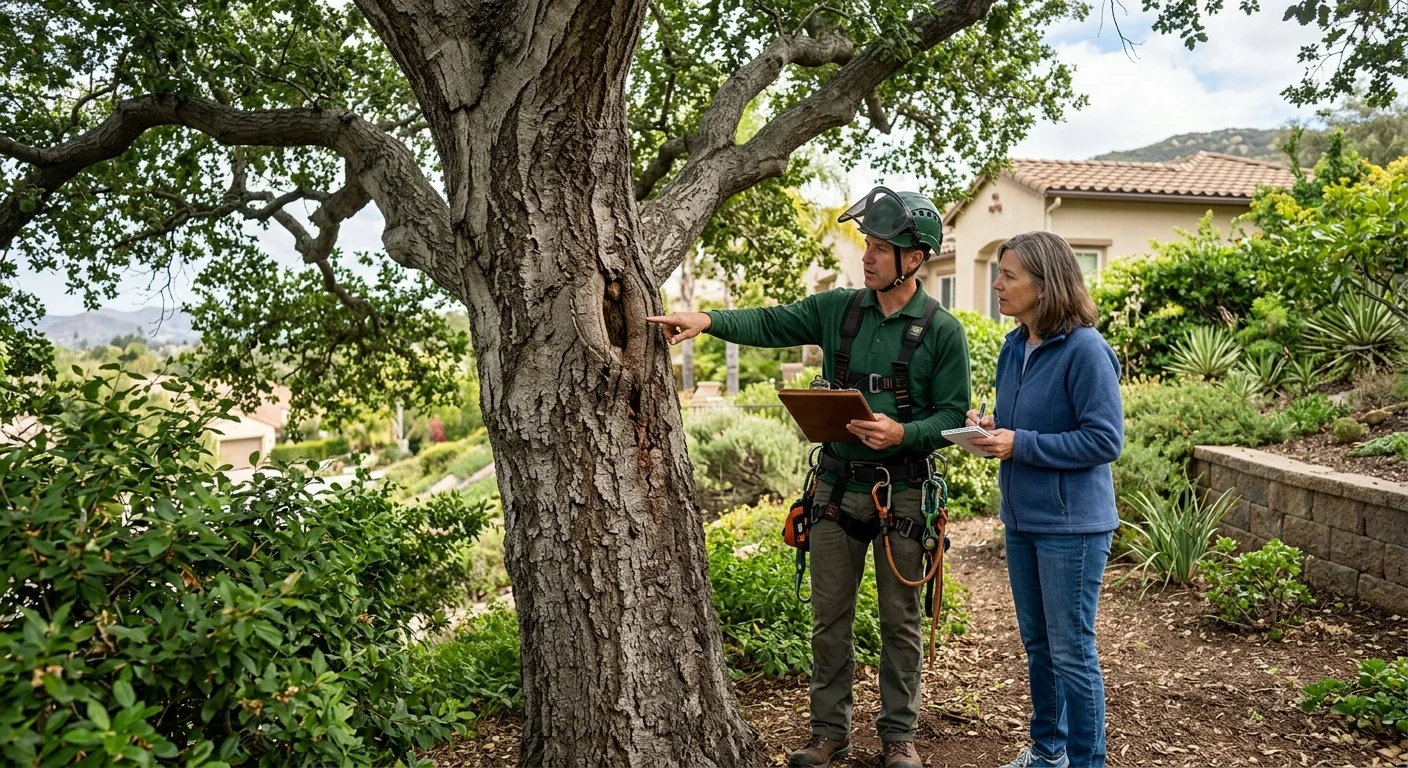
Start with the symptom instead of the desired cut
Rancho Bernardo sits inside the City of San Diego, inland along I-15, with Lake Hodges and open-space canyons on the west and south edges. Lots in Westwood, Oaks North, and The Trails share mature oaks, eucalyptus, pines, and palms, then split on slope, irrigation, and how close the canopy sits to a roof or a fire-break. A trimmer who starts with “take it down a third” is answering a different question than the one you searched.
Write down what you can see from the ground. Crown thinning on one side. Dead twigs in the outer canopy. Bark staining on the lower trunk. A new lean after wind. Leaf drop while neighboring trees of the same kind still look full. D-shaped exit holes on a large coast live oak can point toward goldspotted oak borer, which UC ANR describes as contributing to oak mortality in many parts of San Diego County. Crown thinning and bark stain by themselves do not prove that pest. A few bark-beetle hits on a vigorous tree can be a limited attack. Extensive trunk infestation is a different finding. Keep those observations as notes, and leave the cause to the person who inspects the tree.
Name the target next to the tree. Roof, chimney, walkway, play area, pool cage, or a neighbor’s patio. If the tree sits in the parkway or a City right-of-way, that is a City street tree. City of San Diego Urban Forestry reviews trimming, removal, planting, and root pruning through a no-fee permit after staff inspection. Report City-maintained trees through Get It Done. A private crew’s availability does not authorize work on a City tree.
Power-line conflict belongs to SDG&E first. Stay away from downed wires. Call 911 and SDG&E at 1-800-411-7343 from a safe place. A standing tree leaning toward lines still needs the utility’s direction before anyone plans a cut. That call does not authorize a homeowner or an ordinary crew to work near energized conductors.
If people are at immediate risk, stop and get emergency help. Diagnosis waits until the site is safe to walk.
Record watering, pruning, weather, and site changes
The useful arborist consultation starts with history you already have. Rancho Bernardo yards run hotter and drier than coastal neighborhoods under the marine layer. Turf irrigation often kept a mature tree alive for years. When the lawn goes off, the tree can lose that water with no new emitter at the drip line. Overwatering and poor drainage can look similar: sparse canopy, early leaf drop, decline. Saturated soil starves roots of oxygen. Extra water in a tight clay pocket can make a declining tree worse. Check that water actually reaches the root zone, and keep the root collar dry.
List recent pruning. ISA’s mature-tree guidance treats each cut as needing a purpose. A general upper mark of about 25 percent of live foliage applies to many trees, with less for mature ones, depending on size, species, age, and the job’s objective. Heavy thinning does not automatically improve health. Lion-tailing, which strips interior and lower foliage, weakens structure. Topping, which leaves stubs or weak laterals, stresses the tree and pushes weakly attached sprouts. If last year’s “cleanup” left those patterns, say so.
Note weather and site work. Santa Ana winds, a long dry stretch, a new patio, a trench for irrigation, grade change, or soil piled against the trunk all belong in the record. Construction can crush roots and compact soil. Decline can show up later. Photograph from a place that is already safe. Do not circle an unstable tree, climb, or peel bark for a closer look.
Bird nesting can delay non-urgent work. CDFW describes February through August as typical for many species in California, with timing that varies by species and location, and nesting in some places every month of the year. If work must happen when birds could be nesting, CDFW recommends a consulting biologist’s survey. An occupied nest needs a buffer or a delay until nesting is complete. That is agency guidance, not a permit you can skip by picking a calendar date.
Fire rules are parcel-specific. Rancho Bernardo is served by City of San Diego Fire-Rescue, including Station 33, not Poway Fire. CAL FIRE’s defensible-space guidance describes Zone 1 within 30 feet of structures or to the nearer property line, and Zone 2 from 30 to 100 feet or to the property line. Zone 0, the first five feet, is described as guidance that was not a uniformly enforceable statewide rule as of early September 2026. The City’s own property-owner guide allows maintained trees in that first five feet. Confirm what the fire authority enforces at your address, including easements and MHPA or open-space adjacency. Do not clear a neighbor’s land or dedicated open space without authority. A NIST field study of The Trails at Rancho Bernardo during the 2007 Witch and Guejito fires is history for that named development. It does not describe the condition of trees on your lot today.
Inspect the roots, trunk, branch structure, and canopy
A tree health diagnosis walk should cover the whole tree, from soil to tips, with the person staying on the ground unless they are qualified to go aloft.
Roots and root collar: look for soil heaving, a new lean, mushrooms at the base, girdling roots, grade fill over the flare, and wetness against the trunk. Surface roots lifting a walkway are a conflict to measure. They do not, by themselves, prove a foundation is failing. That question belongs with a qualified engineer if the building is in play, and with a licensed plumber if a sewer lateral is backing up. For City water and sewer, the City’s published split is the meter for water and the lateral to the main for sewer. Confirm your actual utility and who maintains which stretch.
Trunk: look for cavities, cracks, seams, oozing, staining, and mechanical wounds from mowers or prior climbing spikes. On palms, spikes permanently wound the trunk. On oaks, D-shaped exit holes are a specific clue for goldspotted oak borer. Do not treat every stain as that insect. Heavily damaged oaks, lightly infested high-value trees, and uninfested trees sit in different management paths. Keep suspect oak firewood on site until a qualified professional handles it. Moving infested wood is a known way satellite infestations spread.
Branch structure: codominant stems, included bark, cracked unions, hanging limbs, and old topping sprouts each change what pruning can safely do. Supplemental cabling or bracing, when it is even a candidate, is a later decision after wood condition and remaining risk are assessed. A cable does not prove the roots are sound.
Canopy: compare this tree with others of the same species on the same street. One-sided dieback, sudden leaf loss, and early color can follow root injury, drought, salt in irrigation water, or disease. Symptoms overlap. The written findings should say what was observed, what remains uncertain, and what would be needed to confirm a pest or pathogen. Palms need their own eye: dead fronds and fruit clusters are one issue, a green crown with possible hidden trunk decay is another, and Fusarium wilt of Canary Island date palm has no cure. Tool sanitation belongs in that conversation. Do not climb a suspect palm to tap the trunk.
HOA rules, if you have them, come from current management: visible changes, common area, access, insurance, and notice. HOA approval does not authorize work on a City tree, a utility facility, open space, or a neighbor’s property. Civil Code sections 833 and 834 locate ownership by the trunk. A fence is not a surveyed line.
Separate diagnosis from the proposed pruning scope
Diagnosis answers what is happening and how serious it is. The pruning scope answers which branches come off, which stay, and why. Keep those documents apart so a cosmetic request cannot quietly become a health decision.
Ask for findings in writing: species if known, observed defects, likely causes, what could not be confirmed from the ground, and whether retention, monitoring, pruning, treatment, or removal is on the table. Treatment, if discussed at all, is a separate licensed activity. A C-49 or legacy C-61/D-49 tree contractor license does not replace a DPR pest-control business license for applying insecticides, fungicides, or herbicides to trees. ISA certification does not replace either license.
Then ask for a pruning prescription tied to objectives. Clearance from a roof. Deadwood over a walk. Reduction of a specific overextended limb. Structural work on a young tree. ISA treats reduction as different from topping. How much foliage comes off should match species, size, age, condition, and the stated goal. There is no universal best month for every tree in California. Deciduous fruit trees are often assessed in winter when structure is visible. Apricot and cherry are UC’s disease-timing exceptions, with summer pruning before fall rain to limit Eutypa. Citrus often needs little pruning. Oaks need a plan for the actual species and condition, not a countywide calendar. Palms are judged by dead and dying fronds, fruit clusters, the growing point, and disease risk, not by a May-through-July habit.
If the finding is that the tree cannot be kept, the next page is tree removal planning for Poway and Rancho Bernardo, with the same jurisdiction, access, and utility checks. If the finding is keep-and-prune, the crew that later climbs should work from the written objectives, not from a verbal “thin it out.”
California requires a C-49 Tree and Palm Contractor license, or a valid legacy C-61/D-49 issued before January 1, 2024, for tree-service contracts of $1,000 or more, with the statute’s limits on splitting jobs, advertising as a contractor, and employing others. Work that needs a building permit requires a license regardless of cost. Confirm classification against the actual scope on the CSLB license lookup.
Verify the arborist’s credential and written findings
ISA Certified Arborist is a professional credential held by a person. It is not a California license, and it does not authorize the brand that referred you. ISA itself states that the certification is not licensure or authorization to practice. A company name on a truck is not the credential. Ask for the individual’s name, then check ISA’s Find an Arborist resources or ask them to show a current digital certificate. A missing directory listing does not, by itself, prove they lack certification, because participation can be omitted.
The contractor license is the separate check. Look up status, classification, expiration, bond record, and workers’ compensation record. Every active California contractor must carry a $25,000 license bond, or a lawful deposit in lieu of that bond. Workers’ compensation is mandatory when the contractor has employees. Current law lets some licensees with no employees file an exemption, with a short exclusion list that includes legacy D-49 and does not list C-49. Read the actual CSLB record and ask how the job will be staffed. A certificate of insurance is not the policy. Coverage follows the policy’s terms and exclusions.
For a practical hiring sequence, use our guide on how to hire a certified arborist in San Diego. Match quotes only against the same trees, the same diagnosis, and the same proposed cuts. Agree what is excluded: extra trees, grinding, haul-off, permit filing, HOA paperwork, pest treatment, and any written report. Branch Pro San Diego matches you with licensed, independent local tree companies. You contract and pay the professional directly. The referral service does not hold the trade license, does not send “our crew,” and does not promise that every matched person holds an ISA credential.
Bring your notes to that visit: watering history, prior cuts, weather, construction, photos from safe ground, HOA contacts, and whether the tree is private, City, or on a boundary. The written findings should be specific to that oak, eucalyptus, pine, or palm on that Rancho Bernardo lot, including slope, irrigation, and any open-space or utility edge.
Frequently asked questions
How much does an arborist cost in California?
No .gov source publishes an official arborist fee for California or for Rancho Bernardo. Aggregator ranges are not primary evidence, so they stay off this page. Ask the independent professional for a written price after they see the tree, the access, and whether you want findings only or findings plus a pruning or removal scope.
What is the best month to prune trees in Rancho Bernardo?
There is no single best month for every species and every yard. Schedule around the tree’s condition, the objective of the cut, frost exposure inland versus milder pockets, and CDFW’s nesting guidance. Hazard work is assessed when the defect is found, with utilities handled first when lines are involved.
How do I check an arborist credential in Rancho Bernardo?
Verify the person on ISA’s directory or with a current digital certificate, and verify the company on CSLB for the right classification and an active license. Confirm insurance against the actual policy, and confirm who will be on site.
When to call us
Call when a Rancho Bernardo tree shows new decline, a structural defect, or a clearance problem, and you want diagnosis written down before anyone prunes. The licensed local company we connect you with inspects the tree, names the findings, and prices only the work you approve. Call us at (858) 400-4423 and we’ll connect you with a licensed local tree company.