A limb hanging over a Pomerado Road driveway is a different job than a coast live oak on a Green Valley slope. Poway tree trimming starts with the tree in front of you, the grade under it, and how a crew can reach it. Inland heat and Santa Ana winds change the risk. Access on a hillside lot often changes the work more than the species does.
Start with the tree concern the owner wants assessed
Name the problem in plain words before anyone picks up a saw. Roof clearance, deadwood after a dry summer, a lean after a wind event, an HOA height note, or a native oak that looks thin are not the same scope. A licensed local company needs the actual tree, the targets under it, and a path from the street.
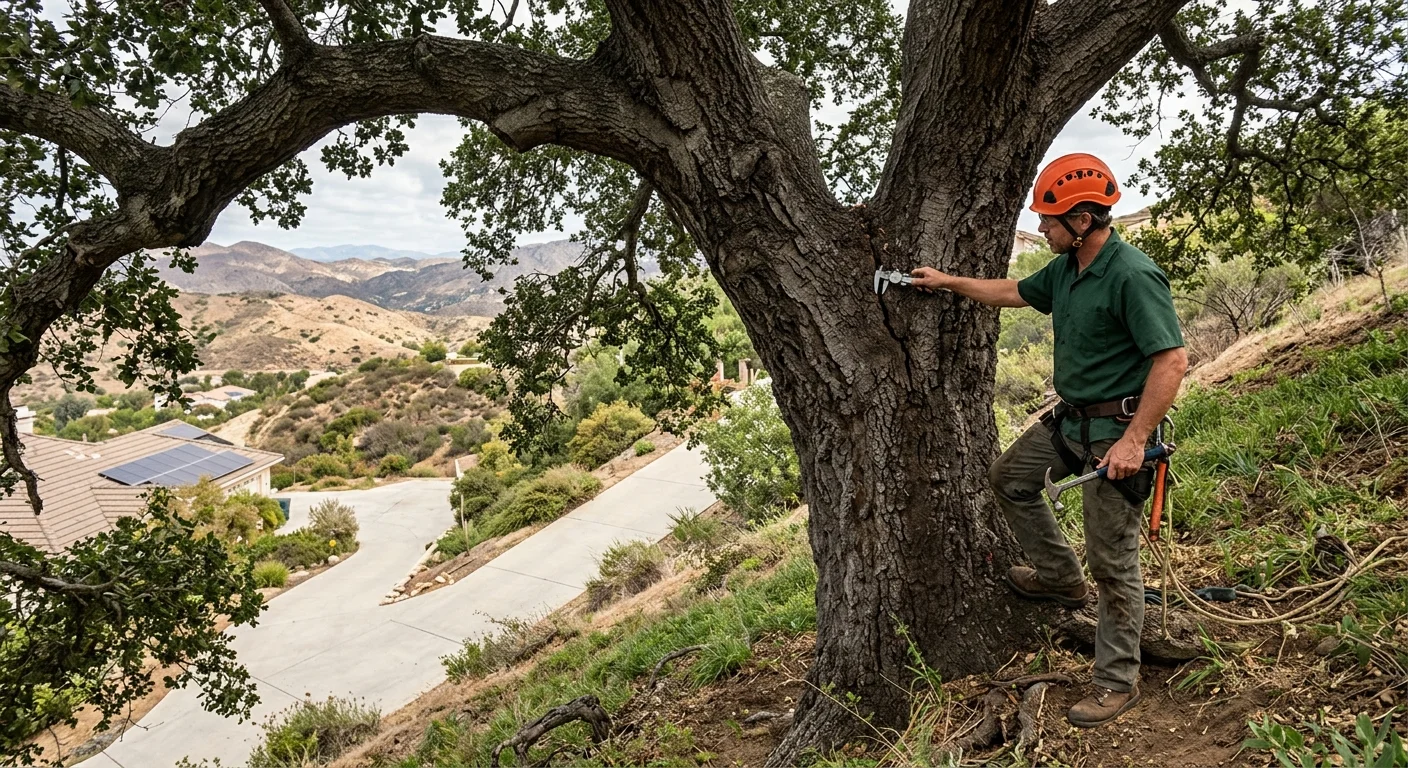
Walk the lot from the curb first. Note gates, parked cars, pool cages, tile roofs, and whether a chipper can sit on the driveway without blocking a neighbor. On a slope, look at how the trunk sits in the grade, not only at the canopy. Heaved soil, a fresh lean, or a split union is a reason to keep people back and get a qualified assessment. Do not climb, winch, or cut from a ladder.
If a line is down, stay away. Call 911 and SDG&E at 1-800-411-7343. The utility decides whether a line can be de-energized, covered, or moved. Ordinary tree work waits on that call. For live overhead conflicts, ask SDG&E before a private crew plans cuts. Do not treat wire height or insulation color as a DIY clearance chart.
Photos from already-safe ground help a quote. Skip close-ups of an unstable tree. Ask the independent company to write the objective: deadwood, clearance, structure, or a keep-or-remove call. Tree trimming and shaping is the service when the tree should stay. If the real question is take-down versus prune, start with that assessment, then read our Poway and Rancho Bernardo removal guide before you hire. Rancho Bernardo sits in the City of San Diego. Poway Fire is not that community’s fire authority.
Branch Pro San Diego matches you with licensed, independent tree companies. We do not trim, climb, or run equipment. The pro you hire contracts with you, and you pay that company directly. Ask for an active California contractor license, C-49 or a valid legacy C-61/D-49, and check it on the CSLB lookup. California requires a contractor license for tree work of $1,000 or more, with the statute’s full conditions. An ISA Certified Arborist credential belongs to a person. It is not a state license. You can verify an individual through Trees Are Good.
How Poway heat, Santa Ana winds, and slope exposure differ
Poway sits inland of the marine layer that cools coastal yards. Summer heat and dry air pull more water through a canopy. A tree that looked full in March can drop interior wood by September. That is a reason to inspect, not a reason to strip live foliage so the tree “uses less water.” Dead branches do not drink. Live canopy is how the tree makes energy. Inland versus coastal timing and stress are different enough that our coastal versus inland trimming guide is worth reading beside this page.
Santa Ana winds are a Southern California pattern, not a one-week fall event. The National Weather Service describes dry desert-to-coast flow through mountain passages, more common in the cooler months, often framed as September through May. That is a season window, not a hard start or stop. Check the current point forecast at weather.gov/sgx for your address. A forecast is time to finish safe prep: move furniture, charge phones, and keep people away from weak unions. It is not time to climb an unstable tree or thin a canopy as a last-minute wind-sail trick.
Slope changes both the tree and the job. A crown on a Lake Poway-facing hillside takes more wind than the same species on a sheltered HOA pad. Equipment setup depends on slope, compaction, drainage, and manufacturer rules. Soft fill, irrigation leaks, and unknown tanks or laterals matter before a truck or lift sits on the grade. Ask the company how they will stage, protect the driveway, and handle chips. Do not assume the street is an automatic work zone. If trucks occupy public pavement, confirm that with the City of Poway before the crew arrives.
Fire rules are address-specific. Poway has its own fire department and a mapped Wildfire Defensible Space Program. Homes in a locally designated Very High Fire Hazard Severity Zone follow Government Code section 51182, with property-line limits and possible stricter local rules. State Responsibility Area parcels follow a different statute. Confirm your map and current requirements with Poway Fire and CAL FIRE’s defensible-space guidance. Statewide Zone 0 rules for the first five feet were not in force as a finished law at the last source review. Current public guidance still describes Zone 1 and Zone 2, limited by a nearer property line, and it allows maintained trees in some local Zone 0 advice. Do not clear every living plant in the first five feet on a rumor. Do not copy a neighbor’s cut list onto your lot.
What Green Valley oaks and newer HOA lots change about access
Green Valley and the older Pomerado corridor still hold large coast live oaks, canyon live oaks, Engelmann oaks, and California sycamores. Those four species are the City of Poway’s defined natives for private-tree removal permits. Heritage trees are a separate City Council designation. Not every big oak is heritage. Poway Development Services requires a private-tree removal permit for native or heritage trees, and on commercial or industrial property for living trees over three inches in diameter. That is a removal rule. Heavy pruning on a native or heritage tree is not something to assume is exempt. Call Development Services with the address, species, and planned cuts before you authorize work.
Public trees are a different desk. Poway Public Works Urban Forestry handles public-tree permits. A tree in the parkway, a median, or a city open-space edge is not yours to schedule with a private crew. A mailing address is not enough. Confirm whether the trunk sits on private land, in the right-of-way, or on city property.
Newer HOA tracts change access more than they change climate. Short driveways, tight side yards, view fences, and guest parking squeeze chippers and boom paths. Gate codes, guest lists, and work-hour rules belong in the written scope. Association landscaping rules sit under the recorded CC&Rs. They do not replace city permits, and they do not replace a fire-authority requirement. Ask the manager which trees the association maintains and which ones the lot owner hires. Street-side strips are not automatically HOA trees.
Clay-heavy fills on some hillside lots hold water after rain and bake hard in August. That affects footing for equipment and how roots sit in the grade. It is a site condition to show the inspector, not a countywide soil map. Irrigation that soaks the root collar while the canopy goes dry is a common inland pattern. Ask the company to look at emitters, grade, and the flare, not only at branches they can see from the street.
If the honest recommendation is removal, stop. Permits, targets, and disposal change. Use the Poway tree service page for local routing, then the removal guide linked above. Do not treat a trim quote as permission to take the tree.
Why topping and heavy thinning need a second look
Topping is cutting a stem back to a stub or to a lateral too small to take the load. The International Society of Arboriculture describes how that stresses the tree, opens tissue to sun injury and decay, and grows weakly attached sprouts. Reduction to a real lateral, with a stated objective, is a different cut. “Make it shorter for wind” is not a specification.
Heavy interior thinning, often sold as lacing, can strip the inside and leave foliage at the tips. That lion-tail shape is poor structure, not a Santa Ana strategy. ISA’s mature-tree guidance treats about 25 percent live-crown removal as a general upper mark, and less on mature trees, depending on size, species, age, and objective. It is not a yearly quota and not a safe allowance for every oak on a slope. Each cut needs a purpose.
Ask for structural pruning in writing: which stems, why, and what stays. Clearance from a roof or walkway can be a real objective. Cosmetic flattening is not. Palms are not shade trees. Dead or dying fronds and fruit clusters are the usual work. Healthy green foliage should stay unless a documented clearance need says otherwise. Spikes wound a palm trunk permanently.
Price talk without a scope is noise. National averages and “reasonable California” round numbers do not describe your driveway, slope, or species. A written proposal should name the trees, the cuts, debris handling, protection for the roof and hardscape, and who pulls any required city permit. The matched company sets its own price. Branch Pro does not.
When trimming should wait for a health assessment
Some canopies need a diagnosis before a prune. Coast live oaks in San Diego County face goldspotted oak borer pressure. Crown thinning, bark staining, and D-shaped exit holes are clues for a qualified look. They are not a home diagnosis and not an automatic removal order. Lightly damaged high-value trees and heavily damaged trees are different cases. Do not move infested oak firewood around the county. Keep suspect wood on site until the company and local disposal rules are clear.
Drought and bark beetles overlap. A few boring insects on a vigorous tree are not the same as a girdled trunk. UC guidance does not support a rule that every beetle-hit tree will die. Extensive trunk infestation, root-plate movement, and hanging failures belong in a keep-manage-remove conversation, not a cosmetic trim.
Birds nest in some Poway canopies every month, with higher risk for many species from February through August, per California Department of Fish and Wildlife. If work must happen when birds could be nesting, CDFW recommends a consulting biologist’s survey. An active nest gets a buffer or a delay until nesting is done. Do not move a nest to “check.”
Hold the saw when you see a fresh lean, soil heave, a split crotch over a bedroom, one-sided palm decline, or staining you cannot explain from the ground. Agree on whether the visit is pruning, a written condition report, or both. The independent provider confirms what is in the quote. Trimming a declining tree can wait a day. A failed union over a bedroom cannot be scheduled as a shape job.
Frequently asked questions
How much does Poway tree trimming cost?
No verified public agency publishes a Poway or San Diego trimming price list. Height, species, slope, access, debris, line conflicts, and permits drive the quote. Ask for a written scope, not a phone number pulled from a national average. Removal of a 30-foot tree is a different job than pruning it. Do not use a removal range to budget a trim.
Do I need a permit to trim a tree in Poway?
Confirm the parcel, the tree’s location, and whether it is native, heritage, public, or private. Development Services handles private-tree removal permits for native and heritage trees, and for larger living trees on commercial or industrial lots. Public Works handles public trees. Call those desks with the address before heavy work. Do not treat an HOA email as a city permit.
Can seniors get free tree cutting in Poway?
A citywide free senior trimming program could not be confirmed from the sources used for this page. Ask the City of Poway, your HOA, and any county program you already use. Do not hire on a promise of a waived fee from this site. Branch Pro does not offer discounts or free work.
What is a reasonable price for tree trimming in California?
A reasonable price is one tied to named trees, named cuts, access, and cleanup, from a currently licensed company. Compare written scopes. Check the license. Coverage follows the insurance policy, not a certificate alone.
When to call us
Call when a Poway tree needs a licensed company to assess heat-stressed wood, Santa Ana exposure, or a sloped lot you cannot reach safely. The independent pros we connect you with prune, and they should confirm city and fire rules for that address before the first cut. Call us at (858) 400-4423 and we’ll connect you with a licensed local tree company.