A South Oceanside ficus scraping a tile roof is a different job from a pepper tree over a wide backyard east of I-5. Same city. Same Oceanside tree service search. The cuts, the access, and who owns the tree still have to match that lot.
Define the pruning goal for the specific tree
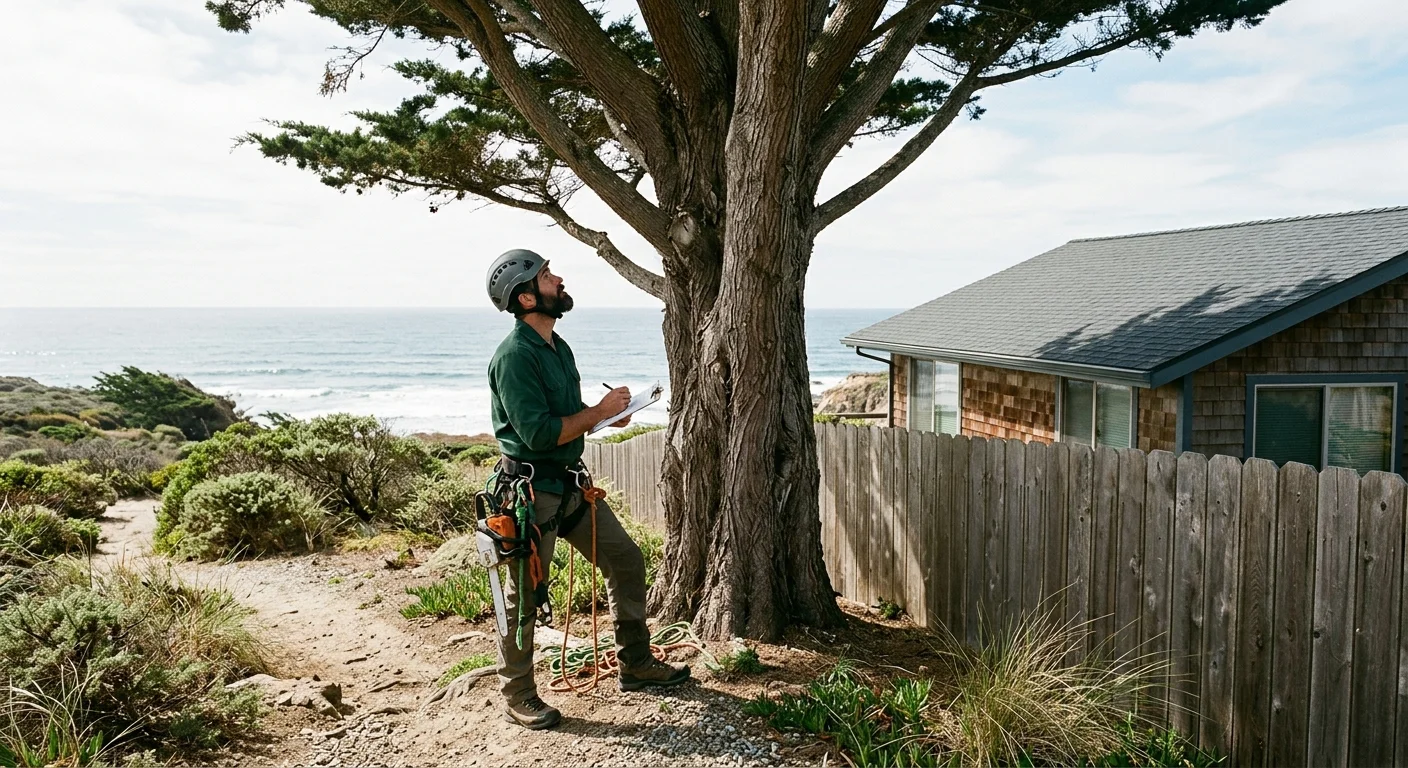
Name the tree and the reason for the cut before anyone climbs. Roof clearance on a Coast Highway bungalow is not the same work as deadwood on a coast live oak, size control on a backyard avocado, or spent fronds on a queen palm. Structural pruning is purpose-based work. It is not a yearly haircut and it is not topping.
The International Society of Arboriculture treats each cut as a decision. A general upper guideline for live-crown removal sits around 25 percent, and mature trees usually need less. That figure is not a target and not an annual quota. Extra foliage removal drains energy the tree uses to close wounds and grow. Lion-tailing, which strips interior and lower foliage and leaves tufts at the tips, weakens structure. Reduction to a real lateral branch is different from cutting to stubs.
Palms need their own plan. ISA guidance for palms focuses on dead or dying fronds and fruit or flower clusters when those parts create a site risk. Healthy foliage stays. The growing point at the crown has to be protected. Climbing spikes wound a palm trunk, and those wounds do not close. Queen palms are not self-cleaning. Dead leaves can need removal. Partly living leaves can still feed the palm. Do not treat a green-frond strip as routine Oceanside maintenance.
Citrus and avocado in inland Oceanside yards usually need little pruning to stay productive. UC Cooperative Extension is clear on that. Heavy thinning that opens the canopy can sunburn newly exposed bark and fruit. If the goal is fruit, say so. If the goal is a walkway, say that instead.
Write the objective in plain English on the quote. Clearance from the roof. Removal of a named dead limb. Reduction of a specified leader. Leave the rest of the canopy alone unless there is a reason. Independent licensed pros do the work. Branch Pro San Diego matches you with those pros. We do not prune the tree.
How salt air west of I-5 differs from hotter inland Oceanside yards
West of I-5, marine air, wind off the water, and tight older lots shape the job. South Oceanside, the Coast Highway grid, and the blocks near the beach often put large canopies over tile roofs, stucco, and narrow side yards. Salt spray can brown leaf tips and margins. UC IPM notes that damage sometimes shows more on the ocean-facing side, or on foliage wetted by saline sprinklers. Root-zone salts are a different pathway. They impede water uptake. Those symptoms overlap drought, so a brown edge is not a remote diagnosis. Soil and irrigation-water testing settle salinity. Coastal address alone does not.
East of I-5, yards around Fire Mountain, Rancho del Oro, and the inland tracts toward Vista tend to run hotter and drier. Water demand rises in hot, sunny, windy, low-humidity weather. A mature tree that used to drink from a lawn can decline after the turf irrigation is cut. Saturated soil can look like drought from the canopy down, because wet roots cannot take up water. Check actual root-zone moisture before anyone writes a water-more or water-less plan.
The coastal versus inland split is real enough to change the inspection, not a license to invent a citywide calendar. Coastal and inland tree work across San Diego County follows the same logic. Species still matter more than the freeway. A eucalyptus, a California pepper, a ficus, and a Torrey pine do not take the same cuts. A palm is not a hardwood. Ask the independent pro to identify the tree on site and to match the pruning objective to that species and that exposure.
Do not use pruning as a drought fix. Thinning the canopy does not save the tree water in the way many quotes imply. Dead branches do not drink. Live foliage makes the food. If the tree is in decline, that is a diagnosis question first. Pruning is not a spray, a fertilizer, or a removal.
Santa Ana wind days still reach the coast, even if inland ridges feel them first. A forecast is a time to finish safe ground prep. It is not a time to climb an unstable tree or strip a canopy because someone called the foliage a sail.
Map roofs, fences, alleys, and street access
Walk the lot the way a crew has to work it. Start at the street. Note parking, driveway slope, gate width, and whether a chipper or lift can sit on private pavement. South Oceanside alleys and side yards often leave a single narrow path between house and fence. Inland lots can be wider and still trap a tree behind a pool, a patio cover, or a block wall.
List every target under the work. Roof, solar, windows, fence, neighbor’s patio, play set, parked cars. A limb over the house is a different drop zone from a limb over an empty lawn. Measure what you can from the ground. Approximate height, the distance to the nearest structure, and the tightest gate. Photos from a safe place help a quote. Do not climb, and do not walk under a cracked or hanging limb to get a better angle.
Neighbor lines matter. In California, a trunk wholly on one lot belongs to that owner even if roots or branches cross. A fence is not a survey. Shared or disputed trees need a conversation and a written scope before cuts. Do not treat the property line as a cutting guide. Unreasonable injury to a tree, even from your side, can still be a problem. Stay off the neighbor’s land unless you have permission.
If the work will occupy the street, sidewalk, or a city easement, confirm that with the city before anyone stages equipment. Do not assume a private backyard job stays private once trucks, cones, or brush sit in the right-of-way. Overhead lines change the plan entirely. Ordinary tree workers are not line-clearance electricians. Keep people and tools away from overhead conductors and call SDG&E when lines obstruct the work.
Access drives the method. A pro may use a lift, climbing, or, on a tight drop, a crane. None of those is automatic because the tree is large. Ground support for a crane depends on slope, soil, drainage, and buried utilities. That is an on-site call for the company doing the lift, not a promise in an article.
Separate pruning, hauling, cleanup, and excluded work
A useful Oceanside quote names the cuts, then names everything else. Tree trimming and pruning are not two different biologies. Industry pruning standards cover both words. What changes is the written objective: health, structure, clearance, size, or appearance. Ask for the branches, the reason, and what stays.
Hauling is separate. So is raking, blowing, driveway sweeping, and whether chips stay on site. Stump grinding is not pruning. Palm skirt or seed-pod work is not the same as hardwood deadwood. Cabling, spraying, and root pruning are different jobs with different credentials. If it is not on the page, treat it as excluded.
Compare quotes the same way you would any other Oceanside tree job. How homeowners compare Oceanside tree-service quotes is about matching scope, not a price list. No public agency publishes an official Oceanside pruning rate, so a page that invents one is guessing. Ask the independent company for a written price on the named trees, the named cuts, cleanup, haul-away, and extras. Confirm who is responsible for irrigation heads, fence panels, and plantings in the drop zone.
California requires a contractor license for tree-work contracts of $1,000 or more, counting labor, materials, and everything else in the job. The current classification for tree and palm work is C-49. Active legacy C-61/D-49 licenses issued before 2024 can still be valid. Check the named company on the CSLB license lookup. ISA Certified Arborist is an individual credential, not a state license, and not a substitute for the contractor license. An absent directory listing does not by itself disprove a credential. Ask the person for current proof.
Birds nest in some form every month in parts of California. CDFW describes February through August as typical for many species, with variation by species and location. If work must happen when birds could be nesting, agency guidance is a biologist survey and a buffer or delay if an active nest is present. Do not move a nest to inspect it.
Check city or utility responsibility before approval
Find out who owns the tree before you approve cuts. Oceanside Public Works maintains city street trees on a grid pruning program. Clearance and condition issues are exceptions. Routine requested pruning is not automatic. The City Arborist reviews removal requests case by case. Blocked views and falling litter are not grounds for removal on city trees. Read the current program on the city street-tree maintenance page.
Private-tree problems are the owner’s responsibility unless the tree belongs to a Landscape Maintenance District. A 92054 or 92056 mailing address is not enough. Confirm whether the trunk sits on private land, in the right-of-way, in a district, or, in a few pockets, on unincorporated county land. A private contractor’s availability does not authorize work on a city tree.
If a limb is in or on a power line, stop. Unauthorized people must not work near energized high-voltage lines. For a downed line, keep away, call 911, and call SDG&E at 1-800-411-7343. The utility decides whether a line can be de-energized, covered, or moved. That is not a tree-company call. Do not condition the report on proving the line is live.
A lot on Camp Pendleton is not an Oceanside backyard job. Work on the installation starts with the housing or facilities authority. A city permit path and a residential quote do not establish permission to work on base.
Fire-clearance rules depend on the parcel, the fire authority, and any easement. Statewide Zone 0 rules for the first five feet were still moving through state review as of early September 2026. Do not treat an article as your inspection notice. If you have a written clearance notice, bring it to the walkthrough so the quote can match the requested work. The issuing authority still decides compliance.
Frequently asked questions
Is there a difference between tree trimming and tree pruning?
The trade uses both words for cutting branches to a stated objective. Appearance versus health is a false split. Ask for the tree, the cuts, and the reason in writing. Topping, lion-tailing, and stripping a palm down to a few upright fronds are poor practice under that same family of standards. ISA’s tree-owner resources explain mature-tree pruning and why topping hurts trees.
Who is responsible for cutting trees in Oceanside?
City street trees follow Oceanside’s maintenance program. Private trees are the owner’s job, except where a Landscape Maintenance District or another recorded arrangement applies. Overhead primary lines belong with SDG&E and qualified line-clearance workers. Confirm location and ownership before you hire.
Who do I call if a tree is down in my yard?
If anyone is hurt, or a line is down, call 911 first. For electrical lines also call SDG&E at 1-800-411-7343. Stay away from the tree, the building damage, and the wires. After the site is safe, a licensed tree company can quote removal or cleanup. That quote is not an emergency-dispatch promise from this referral line.
How often should an Oceanside tree be pruned?
There is no citywide annual rule that fits every species. Palms, citrus, avocado, oaks, and eucalyptus do not share one calendar. Hazard limbs can need attention whenever they appear. Cosmetic schedules should follow a named objective, the tree’s condition, and the independent pro’s plan, not a generic once-a-year promise.
When to call us
Call when an Oceanside tree needs named pruning around a roof, a fence, a tight side yard, or inland heat, and you want a licensed independent crew to put that scope in writing. Branch Pro San Diego is a referral service. We match you with licensed, insured local tree companies. We do not prune, haul, or pull permits ourselves. Call us at (858) 400-4423 and we’ll connect you with a licensed local tree company.