The saws stop and the eucalyptus is on the ground. Now you decide what happens to the wood. Logs, chips, and brush can fill a canyon lot in La Jolla or a side yard in Chula Vista before anyone leaves. Put the stay-or-haul choice in the written scope before the independent crew starts eucalyptus removal.
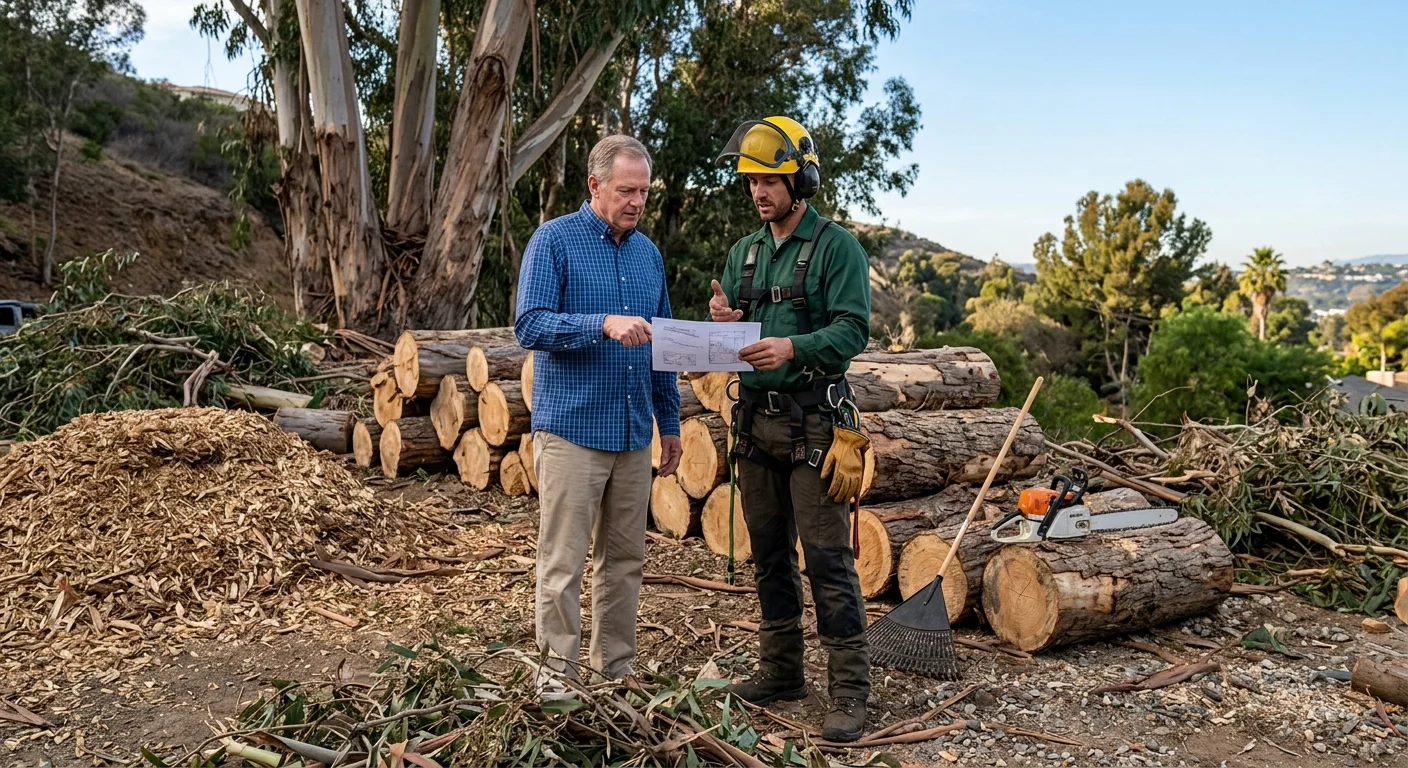
Decide whether logs and chips stay or leave
A quote that only says take the tree down can still leave you with a pile. Ask, in writing, whether logs stay, chips stay, or everything leaves. That choice changes the trucks, the labor, and the last look of the yard.
Keeping logs means you need a place they can sit. They should not block a gate, a walk, or a fire access path. One mature eucalyptus in San Diego can drop a lot of wood in one afternoon. Several trunks at once is a different job. If a row or grove is coming down, read our eucalyptus grove management notes before you agree to leave wood on site.
Chips are a separate material from split rounds. Some owners keep them for paths or beds. That only works if you named a dump spot, a depth, and who rakes them. Chips against siding, under a deck, or in the first few feet around a house are a fire-planning issue. CAL FIRE’s current defensible space guidance treats that near-structure strip as the ember-resistant zone. Confirm the rule that applies to your parcel with the fire authority for that address. Do not treat chips as a fireproof blanket.
Reuse, firewood, and furniture
People searching eucalyptus wood often want chairs, decks, or firewood. Yard wood from a removed tree is leftover material. Graded furniture lumber is a mill product with its own standards. How well leftover eucalyptus lasts outdoors, whether it is a good building wood, and what it is worth could not be confirmed from our approved sources. If you want pieces kept, say how they should be cut, stacked, and left. If you want them gone, say that too. A verbal “maybe we’ll keep some” is how a driveway ends up full of rounds.
Hauling versus leaving also shows up in the price talk. Branch Pro San Diego does not set rates. Compare what each written proposal includes, then use our eucalyptus removal cost guide for the questions that change a quote.
Separate wood, brush, stump debris, and cleanup
Name each leftover on paper. Logs are the trunk and large limbs. Brush is small branches and leafy tops. Chips are what a chipper makes. Stump debris is the butt, the grindings, and the hole. Mixing those four into one “cleanup” line is how a job ends with a stump in the lawn and a brush pile behind the garage.
Tree removal is the felling, the lowering, and the wood on the ground. Hauling is extra unless the proposal says it. Raking, blowing, and a broom-clean patio are extra unless the proposal says those too. A canyon lot in Alpine or a tight Encinitas side yard can hide a surprising amount of twig debris in ice plant and ivy. Walk the fence line in the scope visit and point at it.
The stump is its own decision. Grinding, leaving a low butt, or digging for a future patio are different scopes. If you plan sod, a walk, or a new tree, say the end use before anyone prices stump grinding. Grinding leaves chips and a depression. Those chips are not the same as the pile from the canopy. Say whether grindings stay, get hauled, or get used as backfill, and who brings soil if the hole settles later.
If you hoped for free chips, read our wood chip page and still write the on-site plan. A load that works in a Ramona orchard can bury a Mission Hills patio. The independent company you hire owns that day’s wood handling. Branch Pro San Diego matches you with licensed local pros. We do not take the wood, run a chip yard, or promise a delivery.
Check gates, slopes, streets, and hauling access
Eucalyptus wood only leaves if a truck can reach it. Measure the gate, the side-yard width, and the turnaround. A coastal lot in Encinitas or La Jolla often has a narrow walk, a low arbor, and parked cars on both sides. An inland lot in El Cajon or Escondido may have a wide drive and a steep rear slope. Same species, different haul plan.
Walk the route the wood will travel. Call out stairs, retaining walls, septic lids, irrigation boxes, and lawn you care about. Heavy rounds chew turf. Chips blow into pools. On an East County slope, a pile that looks tidy from the house can sit on a grade that a loaded truck cannot climb. The independent crew should say whether they will carry, roll, crane, or chip in place. A crane is a method for a specific access problem. It is not automatic on every large eucalyptus.
Street space matters as much as the yard. Work that occupies a sidewalk, a travel lane, or a parkway can need city permission even when the tree is private. In the City of San Diego, a street tree is a City tree. A private crew’s availability does not authorize cutting it or keeping the wood. Report City-maintained trees through Get It Done and follow City inspection. Unincorporated pockets such as Lake San Marcos sit under County planning, not the City of San Marcos. Use the parcel and the tree’s actual location, not the mailing city on your bills.
If the job includes grinding or digging, public utility marks and private lines are part of access. DigAlert covers San Diego County. Member marks usually run to the meter. They do not locate every private irrigation line or sewer lateral, and they do not give depth. Arrange private locating where those lines may sit under the stump or the haul path.
Confirm current disposal and transport rules with the authority
Do not guess where eucalyptus wood is allowed to go. Disposal, burning, and green-waste rules sit with the city, the county, or the fire district that serves the parcel. Ask that authority before you pay for a haul plan.
Inside the City of San Diego, start with Environmental Services. City residents with proof of residency can self-load compost or standard mulch at the Miramar greenery under the City’s current limits. Wood chips are a separate, charged product. Confirm today’s rules on the City greenery page. That program does not cover the whole county. Chula Vista, El Cajon, Oceanside, and unincorporated communities each run their own waste path. Call the public works or environmental services office for that address.
Burning is a poor default. The San Diego Air Pollution Control District explains that local fire authorities issue burn permits for a specific place, time, material, and quantity. The district itself does not issue the permit. A clean-air day does not override a local fire ban. Some districts suspend residential burning for long stretches. San Miguel Fire & Rescue, for example, had permitted burning suspended as of May 1, 2026 inside its jurisdiction. That fact does not speak for every district. Ask yours.
Pest handling is also local and species-specific. UC IPM describes eucalyptus longhorned borers as insects whose larvae feed under bark. Holes, ooze, and dieback are signs to have checked. They are not proof of hidden decay or a collapse. Fresh infested wood needs a handling plan. Automatic off-site hauling is not the rule in that guidance, and a home burn pile is not a substitute. If a qualified person flags infestation, keep the wood under that handling plan until the independent company and the applicable agency say how it may move. Do not treat leftover eucalyptus as ordinary firewood for friends across town unless those authorities allow it.
Tree work that totals $1,000 or more, counting labor, materials, and haul-off, requires a California contractor license. The current classification for tree and palm work is C-49. A legacy C-61/D-49 issued before 2024 can still be valid. Check the company on the CSLB license lookup and match the name on the proposal.
Put the final site condition in writing
The last page of the proposal should read like a walk-through. Say where logs may remain, in what lengths, and in which stack. Say whether chips stay, in which beds, and at what depth. Say whether brush is gone. Say what happens to the stump, the grindings, and the hole. Say whether the patio, the drive, and the parkway are broom-clean. Say who repairs turf or irrigation if the haul path damages it.
Take dated photos from the sidewalk, the gate, and the base of the tree before work starts. Take the same frames when the trucks leave. That record settles “the chips were supposed to stay in the back.” It also helps if a neighbor or an HOA asks what left the property.
Name the end use of the ground. A lawn, a gravel pad, a future deck, and a new planting each need a different finish. Iowa State Extension’s stump-replanting guidance is a reminder that remaining roots, altered soil, and old pest or disease issues still matter at the old hole. Grinding alone does not make the spot ready for a new tree. If you will replant, pick a new nearby location when the old root zone is a problem, and agree who brings fill.
Keep ownership of leftover wood in the same writing. If you keep logs, they are yours once the crew leaves, including the work of moving them later. If the company hauls, the proposal should say so in plain words. Branch Pro San Diego does not take title to the wood and does not warrant reuse. The contract is between you and the independent licensed company.
When to call us
Call when a eucalyptus is coming down and you still need a written plan for the wood, the chips, the stump, and the haul route. The matched company should be licensed and insured for the tree work, and the scope should match the yard you actually have. Call us at (858) 400-4423 and we’ll connect you with a licensed local tree company.