A San Elijo Hills stump against a drip line is a different job than a Twin Oaks stump in open dirt. Access, irrigation, and what you want that patch to become decide the scope before any grinder rolls in. Branch Pro San Diego connects you with licensed independent tree companies. Those crews grind. We do not own grinders or run the machine.
Decide how the cleared space will be used
Start with the patch, not the machine. Grass, a patio, a planter, or a new tree each ask for a different finish. Stump grinding cuts the visible stump and nearby wood into chips. It does not empty the whole root system, and it does not leave a finished planting bed.
Iowa State University Extension is clear on the reuse question. Chips, sawdust, and root fragments should come out of soil you plan to seed or sod. Decaying wood can leave voids as it breaks down. Grinding alone does not make the same spot ready for a new tree. A nearby planting location often avoids leftover roots, changed soil, and old pest or disease pressure at the original hole.
That matters on a San Marcos lot. San Elijo Hills yards are tight, sloped, and already planted with drip. Twin Oaks Valley lots are often wider, with more room to shift a new tree a few feet. A Lake San Marcos mailing address can sit in unincorporated county, while San Elijo Hills is inside the city. Confirm the parcel before you treat the stump as a city or county problem.
If the next step is hardscape, say so on the quote. Slab, pavers, and turf are different finishes. Turf prep is not engineered foundation prep. If you want the same hole for a new tree, say that too, and read how grinding and full stump work differ. Agree the intended use in writing so haul-off, fill, and leftover roots are not a surprise later.
A tree removal ticket often stops at the cut. Stump grinding is commonly a separate line. If the tree is already down, you are hiring for the stump, the chips, and the finish, not for another felling.
Document the stump, roots, irrigation, and nearby paving
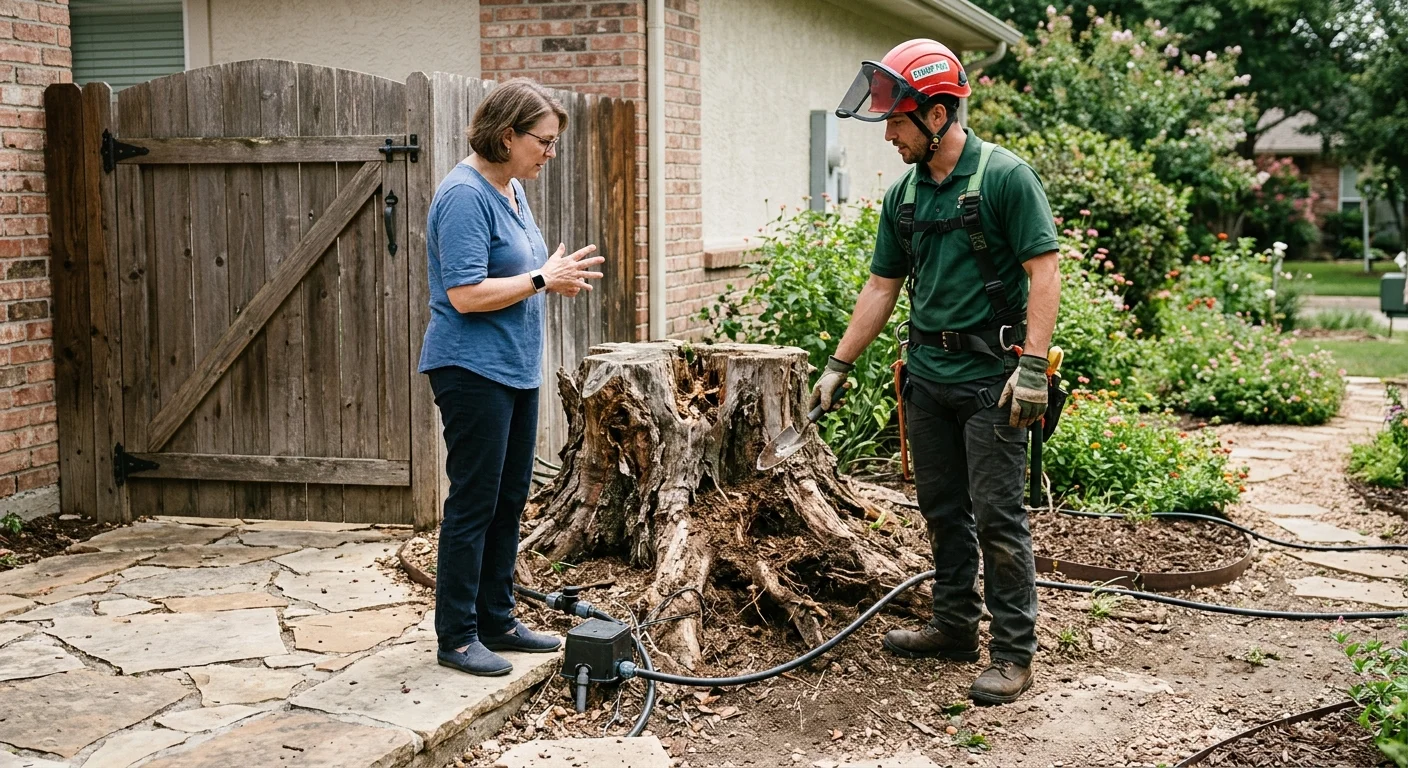
Walk the stump with a phone camera from a safe place. Capture the cut face, the diameter you can see, surface roots, and anything hard next to it: patio, sidewalk, pool deck, fence footer, AC pad. Write down how you measured. Diameter at the cut and diameter at ground line are not the same number. The independent company should agree the measurement method before they price the job.
Look for irrigation next. Newer San Marcos tracts run drip along planter edges and under mulch. Emitters, 1/2-inch laterals, and valve boxes sit right where a grinder wants to work. Flag what you can see. Do not assume a painted public-utility mark covers a private drip line. DigAlert covers San Diego County for member utilities, usually to the meter. Private irrigation, sewer laterals, and other private lines need a separate locate. Marks do not give depth. There is no rule that lines sit deep enough to grind over.
If the stump sits on or next to public property or a right-of-way, stop and check ownership. San Marcos Public Works accepts a tree-removal application for city trees, hedges, and large shrubs on public property or rights-of-way. A private contractor’s schedule is not permission to grind a city stump. For a private-yard stump, no researched city rule here sets a blanket exemption or a California nine-inch heritage cutoff. Confirm the actual parcel, tree location, and any protected designation with the city or County PDS before work.
Note species if you know it. Coast live oak, eucalyptus, pepper tree, and palm stumps behave differently after the cut. Grinding lowers the chance of sprouts from the stump itself. Some species still send shoots from roots away from the hole. Coast redwood is a documented conifer that sprouts from stumps and root crowns. Do not assume every needle-leaf tree is done after grinding.
Map gates, slopes, and machine access on the lot
The machine has to reach the wood. That is the San Marcos problem more often than the stump itself.
San Elijo Hills and similar gated tracts stack side yards, retaining walls, and pedestrian gates. Measure the clear opening, not the gate leaf. Count turns from the street. Note slope, decomposed granite, and wet spots after irrigation. A walk-behind grinder and a larger tracked machine are not interchangeable on a 36-inch side path. The company that comes out should say which machine fits and what, if anything, has to come off the fence or through a neighbor’s side.
Twin Oaks yards can take a wider approach, then still fail on a back-corner stump behind a grove, a horse fence, or a drop toward Twin Oaks Valley Road. Open dirt is not the same as a firm, level setup pad. California crane and equipment rules are a reminder that ground support depends on slope, compaction, drainage, and what sits under the soil. You do not need a crane for most stumps. You do need honest ground.
Ask about HOA or gate access as a site question, not as a published city rule. We have not verified a countywide HOA stump policy, and none belongs on this page. If you live behind a gate, confirm hours, parking, and who meets the crew. If the stump is in a shared slope or along a wall, say so before anyone quotes.
Overhead lines stay in the picture even after the tree is gone. A stump under a service drop still needs space for people and equipment. Stay away from downed lines. Call 911 and SDG&E at 1-800-411-7343 from a safe place, and wait for the utility before any private grinding near that hazard.
For the broader San Marcos tree-work picture, including when a living tree should come down first, use the San Marcos tree service page and the San Marcos tree-removal guide. This page is the stump-access decision after that cut.
Separate grinding, hauling, backfill, and excluded root work
Write four buckets on the quote, even if one company handles more than one.
Grinding: how the stump is measured, how far the grind extends past the visible wood, and that leftover roots can remain. Do not accept a verbal “we take it all.” No source here sets a universal grinding depth, and complete root removal is a different method, usually excavation.
Hauling: chips stay, chips get spread, or chips leave. Spreading chips in the hole is not a planting plan. If you want turf or a tree in that spot, chips and sawdust should come out of the planting soil.
Backfill and grade: who brings fill, who rakes, and who owns settlement later. Decaying wood can leave voids. Ask who returns if the patch sinks.
Excluded root work: surface roots under pavers, roots against a sewer lateral, and roots under a neighbor’s fence are not automatic add-ons. Pipe camera work belongs with a licensed plumber. A tree company grinding a stump is not a sewer repair. Boundary roots are a separate permission and liability problem. A property line is not a cutting prescription.
Tree removal does not automatically include stump grinding. If you already paid for a felling, read the old ticket. If the stump is still there, you are starting a new scope. Full excavation of the stump and major roots is more disturbance than grinding. Use it when the reuse plan actually needs the wood out, not because “removal” sounds more complete.
Chemical stump products are not a shortcut around that choice. A potassium-nitrate stump aid on a current label is a slow decomposer. It is not instant, and it does not itself kill a fresh stump. Do not mix household chemicals, and do not burn the stump. San Diego Air Pollution Control District does not issue burn permits. Local fire authorities do, for a specific place, time, and material, and a permissive air-quality day does not override a local ban.
California tree contracts of $1,000 or more generally need a licensed contractor. Stump grinding sits inside the C-49 Tree and Palm classification, which covers pruning, removal, and stump grinding. Some companies still work under a valid legacy C-61/D-49 issued before 2024. Check the named company on the CSLB license lookup. ISA Certified Arborist is an individual credential, not a substitute for that license.
What to confirm before an independent pro starts
Before anyone starts the grinder, you should be able to point to a written scope that names:
- The stump location, species if known, and the agreed measurement.
- Intended reuse: turf, hardscape, planter, or a new tree nearby or in the same hole.
- Machine access: gate width, turns, slope, and what must be protected.
- Irrigation and other private lines, plus a DigAlert ticket when powered work needs one.
- Grinding versus excavation, and which roots are in or out.
- Chip haul-off, fill, and who owns final grade.
- City or county check if the tree sits in a right-of-way, easement, or unincorporated pocket.
Ask the independent company to confirm duration after they inspect the stump and the grinding depth they actually plan. Do not treat a neighbor’s last job as your clock. Coverage follows the contractor’s policy, not a certificate in a folder. A California insurance certificate is not the policy.
If you want a second set of eyes on a large oak or a tree you still might keep, an individual ISA credential can be checked in the Trees Are Good directory. An absent listing does not disprove certification. Ask the person for their current certificate. That check does not make Branch Pro the contractor.
When the written scope matches the yard you walked, you are ready to hire. When it still says “stump grinding” with no access, irrigation, or reuse notes, it is not ready.
When to call us
Call when a San Marcos stump sits against irrigation, a tight gate, or a reuse plan you care about, and you want a licensed independent tree company to grind it to an agreed scope. Branch Pro San Diego matches you with licensed, insured local pros. We do not grind, haul, or backfill. Call us at (858) 400-4423 and we’ll connect you with a licensed local tree company.