A round, silvery eucalyptus in a Clairemont, Encinitas, or El Cajon yard is not automatically cider gum. Confirm Eucalyptus gunnii before anyone plans a prune, a coppice, or a removal. The wrong name changes the size story, the lookalike list, and the work.
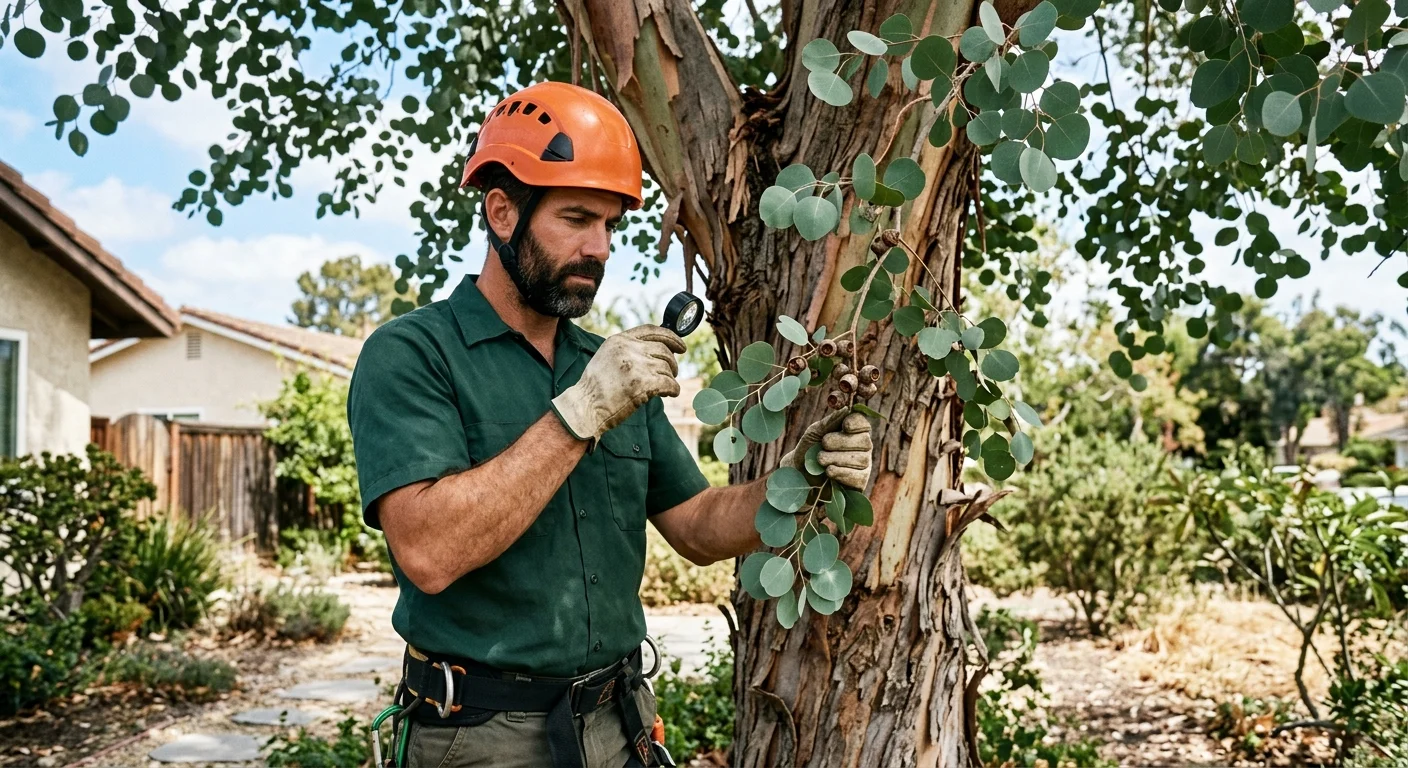
Confirm the species before planning any tree work
Nursery tags, florist bunches, and “silver dollar” photos mix several eucalypts. Eucalyptus gunnii, cider gum, is a real species. Kew’s Plants of the World Online treats that name as accepted, with cider gum as the common name. It is native to Tasmania. California is introduced range, not the wild home of the tree.
That does not prove the tree on your lot is cider gum. It also does not prove cider gum is a common street tree in San Diego. The City’s urban-forest counts do not rank this species, and no county planting census in our sources lists it as widespread. Treat a tag as a clue. Ask for the botanical name in writing before irreversible cuts.
Cider gum is one of several types of eucalyptus sold for round, waxy juvenile leaves. Adult foliage looks different. A tree kept as a foliage shrub and a tree left to form a trunk are the same species at different stages. UK garden copy that frames E. gunnii as a small ornamental does not describe a measured San Diego canopy. Australian floras describe a small to medium tree that can become a large landscape eucalypt. Use the actual height, spread, and targets on your lot, not a catalog size.
Do not crush leaves, strip bark, or climb for a sample. Photograph bark, both leaf types, buds, and fruit from the ground. Fallen capsules in a mixed stand may belong to another tree. If the job is a large prune or eucalyptus removal, have an independent arborist confirm the name on site.
Compare bark, leaves, and seed structures with lookalikes
Use several characters together. Bark color alone is a weak test. Leaf color varies with age, sun, and water. EUCLID, the Australian identification work built from herbarium specimens, treats rough-bark extent, juvenile versus adult leaves, buds, and capsules as the working set.
Cider gum bark is mostly smooth and sheds in patches of cream, grey, green, or dull orange. Rough, persistent bark can sit on the lowest part of the trunk. Young stems may be round or square in cross section. Juvenile leaves sit opposite, without a stalk, and look heart-shaped to almost round, often grey-green or waxy blue. Adult leaves sit alternately on stalks. They are lance-shaped to egg-shaped, dull grey-green or bluish on both faces, not a long glossy sickle. Flower buds sit in the leaf axils in threes. Fruit is a small woody cylinder or barrel, with the valves near the rim or tucked inside.
Silver-dollar gum, Eucalyptus cinerea, is the usual mix-up. Its crown often keeps round, stalkless, very glaucous leaves instead of switching cleanly to stalked adult blades. Do not call every round blue leaf cider gum. Read our cinerea owner checks beside this page when the foliage never “grows up.”
Blue gum (Eucalyptus globulus) is a different tree. The common subspecies usually carries one large, warty, almost stalkless bud, then a big ribbed capsule. Adult leaves are long, glossy, and sickle-shaped. A huge solitary bud is not a cider-gum character.
Red box, Eucalyptus polyanthemos, can also show roundish grey leaves. Its buds typically sit in sevens, and fruit shape differs. Smell is not ID. Lemon-scented gum may or may not smell of lemon when crushed, and crushing is not a safe field test from a ladder.
Nursery names such as “Silver Drop” do not settle the species. Ask the botanical name, then match bark, adult leaves, bud number, and fruit on the actual tree.
Document canopy, trunk, and root-area changes without diagnosing
A San Diego eucalyptus assessment starts with what you can see from a safe place. It does not start with a pest name. Note live crown versus dead wood. Note one-sided thinning versus even density. Note a new lean, soil lifting at the root flare, cracks in unions, or hanging limbs. Photograph the trunk from more than one side, the flare where it meets soil, and whatever the tree could hit: roof, play set, patio, or lines.
Peeling bark on a gum is often normal shed, not a disease test. UC IPM describes eucalyptus longhorned borers as larvae under bark, with holes, ooze, or dieback as signs, not proof of internal decay or certain collapse. Stress, site, and species matter. Redgum lerp psyllid is a sucking insect. Honeydew and sooty mold are not the same as borer galleries. Do not treat a photo as a diagnosis.
Summer branch drop is documented on eucalyptus as well as oaks. Apparently sound limbs can fail on a hot, still day. That is a reason to record large overextended limbs and targets. It is not a rule that every cider gum must come down.
Keep notes on water and recent site change. New paving, grade cuts, or a lawn that stopped getting water can stress a tree that used to share that irrigation. Saturated soil and drought can look similar in the canopy. A brown crown is not an automatic instruction to water more.
If lines are down, stay away and call 911 and SDG&E at 1-800-411-7343. Do not walk in for photos. For a standing tree with no electrical emergency, ground photos and a written condition list help the independent company quote the right scope. Tree health diagnosis is a separate service from a removal bid.
How placement on the lot changes the work discussion
Cider gum’s local problem is rarely winter kill. Tasmania’s high plateau is colder than most San Diego yards. Coastal lots from La Jolla through Pacific Beach sit in marine air. Inland lots in Escondido, El Cajon, and Ramona take harder heat and Santa Ana wind. The same species can be a foliage shrub against a garage in Point Loma and a tall screen on an East County canyon rim. Placement, not a hardiness slogan, drives the work.
Ask how close the trunk and drip line sit to the house, a neighbor’s roof, a pool, or a driveway. Ask about overhead lines and who owns the tree. A City of San Diego street tree is not a backyard tree. Report City-maintained trees through Get It Done. A private contractor’s schedule is not permission to cut a public tree. Other cities and unincorporated County land use different paths. Confirm the parcel, the tree’s location, and the agency before work.
Fire rules are parcel-specific. California’s 100-foot defensible-space framework applies in State Responsibility Areas and Very High Fire Hazard Severity Zones, and local fire authorities can be stricter. Statewide Zone 0 rules for the first five feet were not a fully in-force removal mandate in the last official review we logged. CAL FIRE’s current wildfire-prep page is the place to start, then confirm the address with the fire department that actually covers it. Do not clear a neighbor’s land or an open-space easement on a species guess.
Keeping cider gum “small” is a management plan, not a height cap. Some landscapes coppice or pollard to hold juvenile foliage. That is repeated, purposeful cutting, agreed in writing. It is not topping, and it does not make a mature tree beside a bedroom window small. ISA’s mature-tree guidance is purpose-based cuts, with less foliage removal on older trees, not a yearly size control quota.
Bird nesting can affect timing. CDFW describes February through August as typical for many California species, with nesting possible in other months. An active nest is a reason to pause and get biological guidance, not a calendar that green-lights work.
When an independent arborist assessment may help
Call for an independent look when the name is still unsettled and the job is large. Call when a lean is new, soil has heaved, a big limb hangs, or the tree sits over a roof or play area. Call when you want a keep, reduce, or remove decision tied to this tree, not a genus scare.
ISA Certified Arborist is a credential for a person, not a California license and not a promise about every referred worker. You can ask the actual person to show a current credential and check TreesAreGood. Paid tree work in California still runs through contractor licensing. For contracts of $1,000 or more, the company needs an active C-49 Tree and Palm license, or a valid legacy C-61/D-49 issued before 2024. Confirm the number on the CSLB license lookup. Branch Pro San Diego is a referral service. We match you with licensed local pros. We do not climb, prune, treat, or remove the tree.
Bring your photos, the suspected botanical name, lot access notes, and what you want the tree to do: stay as a screen, hold juvenile foliage, come down, or only drop risk. Agree in writing whether the visit includes identification, a condition opinion, pruning objectives, or a removal and stump plan. Wood handling for infested eucalyptus is part of that scope, not a homeowner hauling recipe.
When to call us
If the tree is cider gum or another eucalypt, and you need identification, a condition check, pruning with a stated objective, or removal, that work belongs with a licensed tree company. Call us at (858) 400-4423 and we’ll connect you with a licensed local tree company.